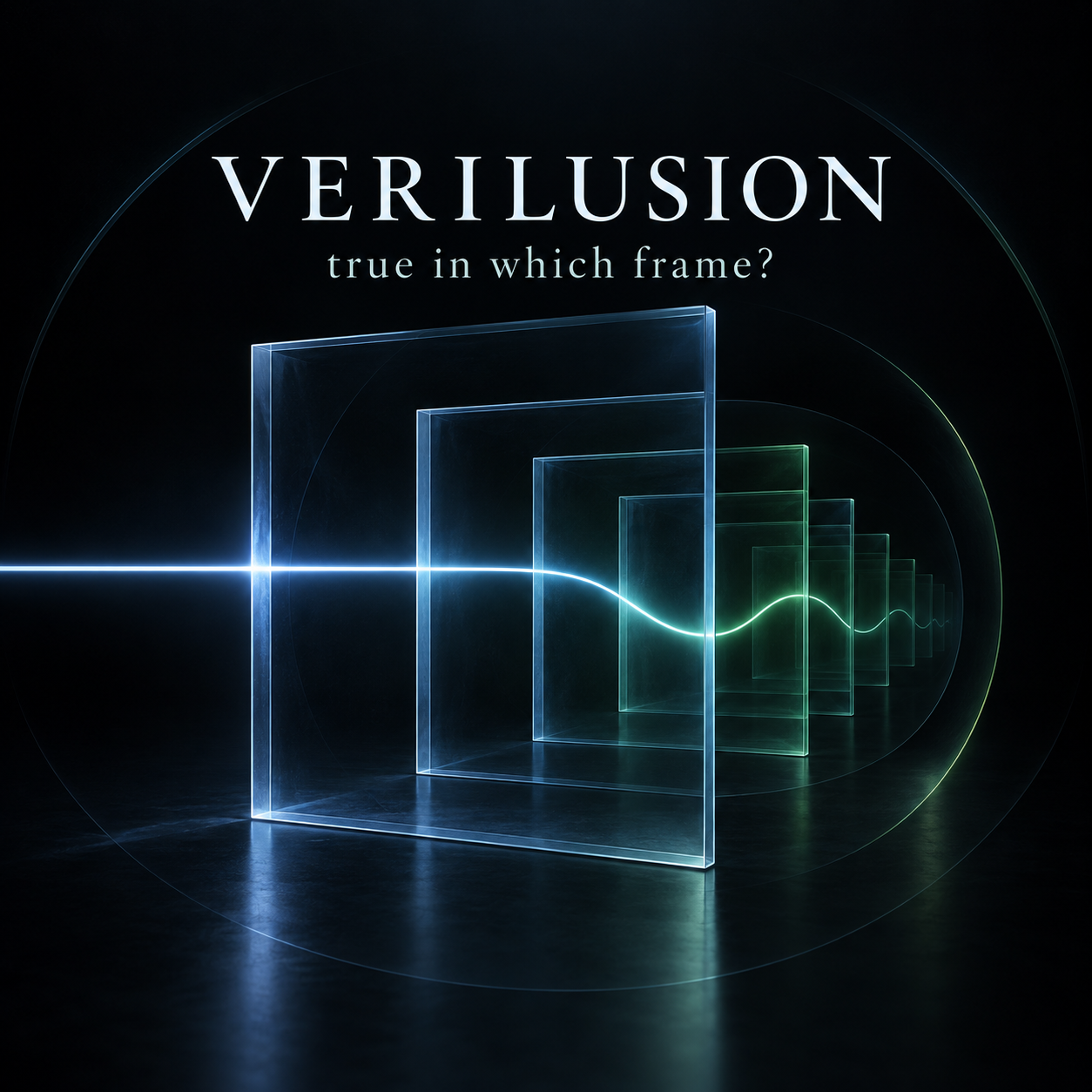
verilusion /ˌvɛrɪˈluːʒən/ (ver-i-LOO-zhun) — noun. Plural verilusions. Adjective verilusive /ˌvɛrɪˈluːsɪv/ (ver-i-LOO-siv). Adverb verilusively.
A concept that holds reliably within its native frame of experience or theory, is displaced by a deeper frame, which is itself subject to displacement in turn — a cascade with no known end. Its status resolves only relative to frame and context, not as simply true or false.
Definition v1, 2026-09-26. A stake in the ground, open to refinement.
Etymology
From Latin veritas (truth) + illusio (illusion — literally a mocking, a play upon). The fusion is the point: not truth, not illusion, but the condition of holding-true inside a frame that a deeper frame will unseat. The pronunciation rhymes with illusion deliberately — the ear hears the resemblance as a warning the mind has to learn.
What it names
Almost our entire vocabulary of belief is binary: true or false, fact or myth, right or wrong. Verilusion names the large territory this binary cannot map — the concepts that work, that predict accurately, that coordinate whole civilizations, and are nevertheless not final.
“Light travels in a straight line” built optics, lenses, and cameras. It is also false: in general relativity, light follows geodesics through curved spacetime, and the “straight line” was a flat-space approximation all along. Both the working rule and its displacement are true of something. Neither is true simply. The wrong question is “is it true?” The right question is “true in which frame — and what displaces the frame?”
Seed examples
- One plus one equals two. Holds in the arithmetic of discrete, non-interacting objects. Frays at the edges — one drop of water plus one drop of water is one larger drop — and dissolves as a claim about the world the moment counting itself, and what counts as “one,” is examined.
- Light travels in a straight line. The working assumption of classical optics; displaced by general relativity, where there are no straight lines, only geodesics.
- We see through glass. Holds in geometric optics. Displaced by quantum electrodynamics, where “seeing through” is a transmission probability and the glass is mostly empty space doing something complicated with photons.
- Gravity pulls us down. Newton: a force. Einstein: curved spacetime, no force at all — things fall because spacetime tells them how. Whatever comes next will keep the falling and rewrite the reason.
- The stars wheel in a circle overhead. The working sky of every pre-telescopic civilization; displaced by heliocentrism, then by galactic rotation, then by cosmology. Each displacement kept the wheeling — it is still what you see — while moving its cause somewhere else entirely.
The cascade
The load-bearing clause is “which is itself subject to displacement in turn.” A verilusion is not a stepping stone toward final truth — that framing smuggles in the very final-frame fantasy the word exists to dissolve. Each frame is native to some range of experience, genuine within it, provisional beyond it, and the succession has no known end. To call something a verilusion is therefore not to debunk it. It is to locate it: this holds here, fails there, and the boundary is part of the concept.
What it is not
- Not illusion or delusion. Those imply a final truth available to contrast against. A verilusion’s displacing frame is itself provisional.
- Not approximation. Approximations converge toward a known limit. Verilusions are as often displaced sideways as refined — the new frame redefines the terms, not just the decimals.
- Not relativism. “Resolves relative to frame and context” is a precision instrument, not a shrug. Inside its native frame a verilusion can be exact, reliable, and checkable. The claim concerns the status of truth, not its absence.
Why the word is needed now
Two pressures make it load-bearing. First, artificial intelligence is trained on the text of every human frame simultaneously and reproduces them all fluently, with no native frame of its own — a machine that speaks entirely in verilusions needs the concept the way medicine needed iatrogenic: you have to name the condition before you can treat it. Second, the displacement cascade is accelerating: frames are falling faster than our vocabulary for frame-fall has grown. We keep asking “but is it true?” of things the question cannot hold.
The 200 Wrongs connection
The 200 Wrongs project is a catalog of verilusions: two hundred entries, each a concept that holds inside its native frame and breaks at a boundary, indexed by the cognitive generator that produced it and the substrate that carries it. If verilusion is the noun, the corpus is the evidence.
Coinage
Coined September 26, 2026, by Frank with Muse, in the course of work on the 200 Wrongs project. Pronunciation ver-i-LOO-zhun. This essay is the first published attestation of the word and its v1 definition.
Frank Kurka
kurkalabs.dev