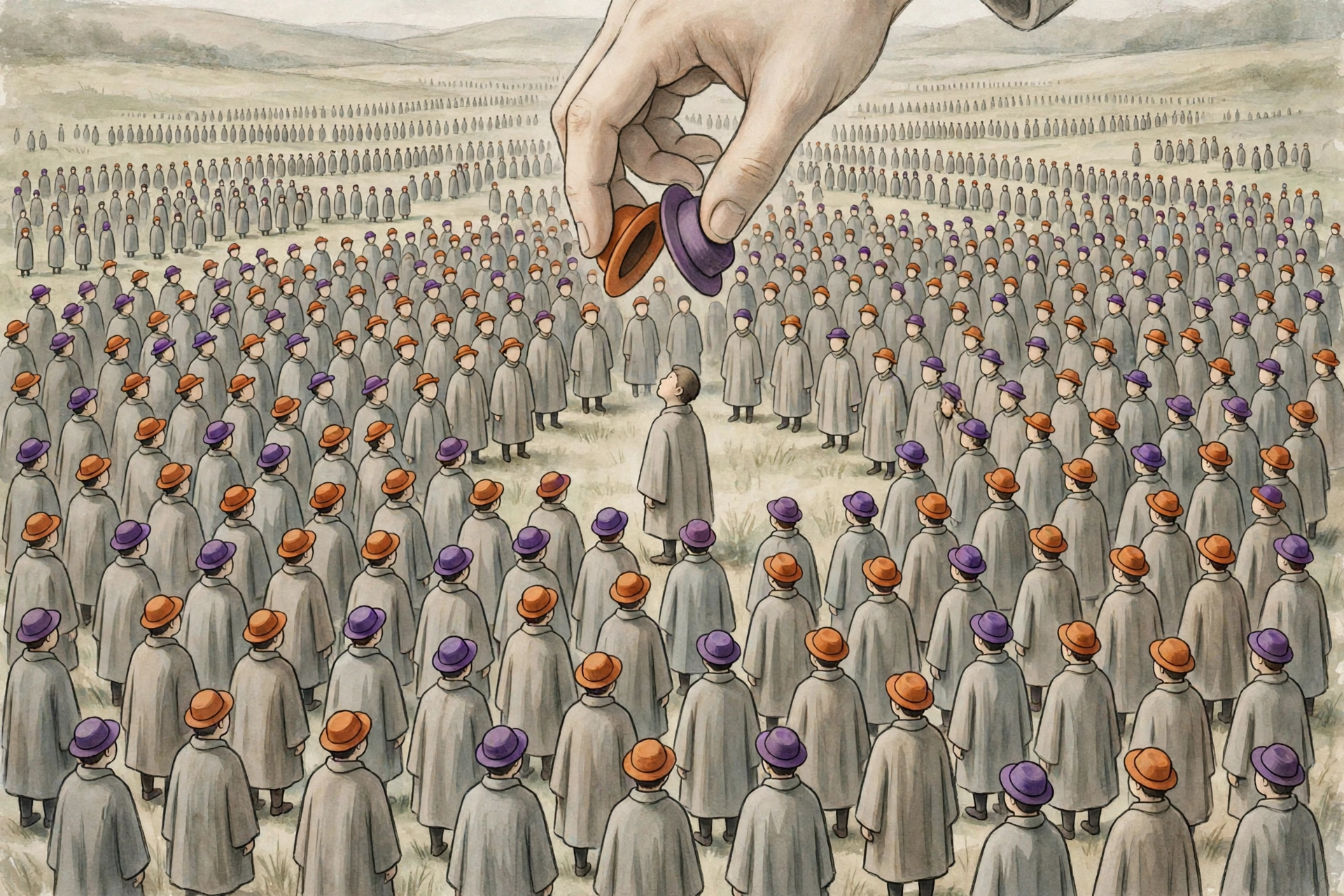
This morning I watched a cartoon. A crowd of identical figures stands in a field, and a hand comes down and puts hats on them — orange on some, purple on others. Nothing else changes. Within minutes the orange hats won't sit near the purple ones. A single prize appears between the groups, and the shouting starts. Forcing them together doesn't help. Taking the hats off doesn't help either. The teams outlive the hats.
The cartoon is a simulation of real experiments. In 1970 and 1971, the psychologist Henri Tajfel took Bristol schoolboys and sorted them by almost nothing — by whether they overestimated or underestimated dots on a screen, by whether they preferred paintings by Klee or by Kandinsky, in one condition by the open toss of a coin. Then he let them hand out rewards to anonymous boys identified only by group. The boys favored their own label every time. More than that: given the choice, they preferred arrangements where their group beat the other group by more over arrangements where everybody got more. Beating the other hat mattered more than gaining.
That is the machinery, demonstrated under laboratory conditions, replicated for fifty years: categorization alone — no history, no grievance, no contact, no gain — is enough to start the tilt. Later work refined the picture in ways that matter. The tilt is mostly love of one's own, not hatred of the other. And it is lopsided: people will tilt rewards toward their own label freely, but they largely refuse to tilt punishments. Handing your side extra is human. Arranging for the other side to carry the burden is something else.
So here is the question the cartoon leaves on the table. The experiments explain what populations do all by themselves. But when division erupts at scale, in the wild, on schedule — how much of it is just us, and how much of it is worked? Is anyone handing out the hats?
The honest answer, up front: we don't know. Anyone certain in either direction is selling something. The people who see a foreign hand behind every quarrel and the people who see no hands anywhere share a method — certainty first, evidence afterward, if ever.
What we do know is that the question is not unanswerable. Influence operations, when they exist, leave evidence of kinds that can be recorded. Coordination has a shape: accounts that move in lockstep, narratives that ignite in a ring of early amplifiers before they walk into the mainstream with their origins washed off. Recurrence has a fingerprint: operations change their names constantly and their habits slowly, which is how patient watchers tracked one Chinese network, Spamouflage, across years of disposable accounts — by its manners, not its masks. And there is a standing warning from the science itself about what counts as a tell: reward-tilting is the human baseline, cheap and everywhere. Burden-shifting — a population being taught to load costs onto the other hat — is the stronger signal that somebody may be working the crowd.
What seems to be missing is not technique. It is the record. Detections happen in episodes — a report, a takedown, a news cycle — and then the memory dissolves and the next operation starts from a clean slate against a public that has forgotten the last one's manners. Recurrence is invisible without a memory that outlives the episode.
So we are going to build the memory, and we are going to look.
The project — we call it The Influencers — is a registry, kept the way we keep our other records: fingerprints as cards, episodes as instances, provenance traveling with every entry, nothing erased, only amended. It watches behavior — coordination, provenance, recurrence — and it never adjudicates viewpoints; an opinion is not evidence of anything except itself. It begins by calibrating against operations already unmasked, proving it can catch what is known to be there before it is allowed to say anything about the live world. It files its false positives as first-class records, because a detector that hides its misses will manufacture the very thing it hunts: call enough of your neighbors foreign agents and you have handed out hats yourself.
And it starts from the hardest assumption, the one Tajfel forces on us: the null hypothesis is us. Division needs no divider; the experiments prove the machinery is built in. An unseen influence has to earn its card against that baseline, episode by episode, receipt by receipt.
Why bother? Because a people that cannot tell its own quarrels from worked ones is governable by anyone with a box of hats — and a people that calls every quarrel worked has already put the hats on itself. Between those two failures is a narrow path, and it is paved with records.
Who influences America's minds? Not that we know. But we are going to look — carefully, in the open about our method and careful about our claims — and find out.
The registry is being built now. Subscribe free to follow what it finds:
Subscribe free →Receipts and editions: Canonical home: this page. Editions: Substack (forthcoming — complete draft held at the editor's image fence) · Beehiiv · Medium · X · LinkedIn · Facebook · Threads · Instagram · Bluesky. Series home: Fieldwork Notes — subscribe free: https://fieldworknotes.substack.com/subscribe